Learn how to play Block Puzzle by fitting supplied shapes into a grid and completing rows or columns. The worked example uses a small teaching grid; the actual practice board below keeps its own size and goal.
Worked example
Find room for the supplied piece
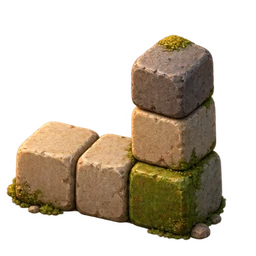
The bottom row already has three filled cells. The two-cell horizontal piece can fill the remaining gap. The piece keeps its supplied direction.
1 / 4
A small teaching grid. The full practice board below keeps its own size, goals and rules.
Worked example
Check the placement preview
The two outlined cells are inside the grid and empty. The piece fits without overlapping an occupied cell. Check the whole shape before placing it.
2 / 4
A small teaching grid. The full practice board below keeps its own size, goals and rules.
Worked example
Complete a row
The new piece fills the last two cells in the bottom row. All five cells are now filled, so that row can clear. Complete columns clear too.
3 / 4
A small teaching grid. The full practice board below keeps its own size, goals and rules.
Worked example
Look at the space you leave
The completed row clears. Before the next placement, compare the shape of the empty space with the next supplied pieces. A legal move is not always the most useful move.
4 / 4
A small teaching grid. The full practice board below keeps its own size, goals and rules.
Fit shapes into the grid and complete rows or columns.
Connecting to the puzzle…
In Edgekin
This puzzle, a bigger world
Help rebuild the island’s walls.
In Edgekin
Practice at the Watchpost
Try thirteen puzzles for free at the Watchpost and Lantern in Edgekin. Choose a familiar board or learn different rules.
In Edgekin
A light for wandering kin
Tend the lantern and meet the kin that find their way to your beacon.
In Edgekin
Explore the island in Edgekin
Meet the kin and begin restoring your own island.
In Edgekin
A home among the clouds
Restore the Home to make room for the kin who arrive at your beacon.
In Edgekin
Keep the island’s memories
Your Chronicle holds the story cards you receive. Return to the book to revisit an event.
In Edgekin
Thirteen puzzles, different decisions
Swap pieces, place shapes, match tiles or use logic. Each mechanic belongs to the same island world.
In Edgekin
Follow the light into Edgekin
Your island and its collection are waiting in the side panel. Practice boards keep their own progress here.
Block puzzle rules
Place a whole shape inside the grid without overlapping occupied cells. The pieces keep the orientations supplied by this game. A completely filled row or column clears. Partly filled lines stay on the board, so every placement changes both your progress and the room available for later shapes.
Read the placement preview
Compare the complete footprint of the piece with the empty cells before releasing it. The preview distinguishes a position that fits from one that crosses an edge or an occupied cell. A shape cannot be placed just because its first cell fits; every cell in the shape must fit.
Follow a complete line
In the example, the bottom row already contains three filled cells. A two-cell horizontal piece fills its remaining gap. When every cell in that row is occupied, the row clears. The example does not imply that the full game uses a five-by-five board or that every move clears a line.
Block puzzle strategy: keep usable space
Compare the empty space after a move with the shapes you can see. A narrow isolated gap may be harder to use than a larger connected area. Clearing a line can create room, but do not assume the first legal placement is the best one. The next supplied pieces and the actual board determine what is useful.
Block puzzle tips: compare before committing
Look at corners, long edges and near-complete lines. Check whether a placement blocks a useful area or leaves room for a wide shape. These are ways to compare choices, not a promise that a single rule solves every board. Use the actual placement preview instead of estimating from the picture alone.
Try the full practice board
The board above uses the shared Block Puzzle controller and its real rules. The footer shows the current line goal and remaining pieces when relevant. Use the information button for controls or expand for more room without restarting. The session needs a connection and stays separate from Edgekin resources and rewards.
 Edgekin