Learn how to play Mahjong Solitaire by checking two things: do the pictures match, and can both tiles be taken? Use the three-step example, then try the actual practice board below.
Worked example
Look for a free pair
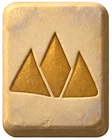
The outer tiles A and D match. Both have a free side and nothing on top. The upper tile covers B and C, so neither lower tile is available.
1 / 3
A cropped part of a pile, not a complete game. Use the practice board below for an actual game.
A
B
C
D
Worked example
Choose two available matching tiles
Choose A and D. A matching picture is not enough: both tiles must be free. B and C remain covered even if you can see most of their pictures.
2 / 3
A cropped part of a pile, not a complete game. Use the practice board below for an actual game.
A
B
C
D
Worked example
A free side is not enough when a tile is covered
A and D disappear. B and C now have free sides, but the tile above still covers both. Clear covering tiles before trying to select the tiles underneath.
3 / 3
A cropped part of a pile, not a complete game. Use the practice board below for an actual game.
Try thirteen puzzles for free at the Watchpost and Lantern in Edgekin. Choose a familiar board or learn different rules.
In Edgekin
A light for wandering kin
Tend the lantern and meet the kin that find their way to your beacon.
In Edgekin
Explore the island in Edgekin
Meet the kin and begin restoring your own island.
In Edgekin
A home among the clouds
Restore the Home to make room for the kin who arrive at your beacon.
In Edgekin
Keep the island’s memories
Your Chronicle holds the story cards you receive. Return to the book to revisit an event.
In Edgekin
Thirteen puzzles, different decisions
Swap pieces, place shapes, match tiles or use logic. Each mechanic belongs to the same island world.
In Edgekin
Follow the light into Edgekin
Your island and its collection are waiting in the side panel. Practice boards keep their own progress here.
What makes a tile free
A tile is available when no other tile covers it and at least one of its left or right sides is open. A visible picture does not necessarily mean a tile is free. The practice board dims blocked tiles so that you can distinguish availability from appearance.
Choose a matching pair
Select two available tiles with the same symbol to remove them. The game uses its visible symbols as the matching rule; it is not the four-player game of Mahjong, and you do not build a winning hand. A pair can be impossible to use when either member is covered or blocked on both sides.
What changes after a pair disappears
Removing a pair can open a side, uncover a lower tile, or do both. Check the new position before choosing again. In the worked example, removing the outside pair opens the sides of B and C, but the upper tile still covers both. Their pictures are visible, yet neither is available.
Mahjong Solitaire tips for the next choice
When several copies of one symbol are free, compare the pairs before selecting one. Prefer a pair that opens a useful tile or releases a blocked area, but inspect the actual pile rather than treating that as a guarantee. Clearing an easy pair is not always the best way to reach a tile you will need.
A common mistake: matching only by picture
Seeing two identical pictures is only half the check. First confirm that each tile is available. If a tile does not respond, inspect what covers it and whether both sides are occupied. Do not mistake a blocked tile for a connection delay.
Practise with the real board
The board above is the same shared Mahjong practice game used elsewhere on Cozy. Its information button explains the controls and the current goal. Expand it to inspect the pile without changing the puzzle. Free shuffles, when available, keep cleared pairs cleared; the board shows the remaining allowance. Practice needs a connection and keeps its own progress separate from the Edgekin island.
 Edgekin
 A
 B
 C